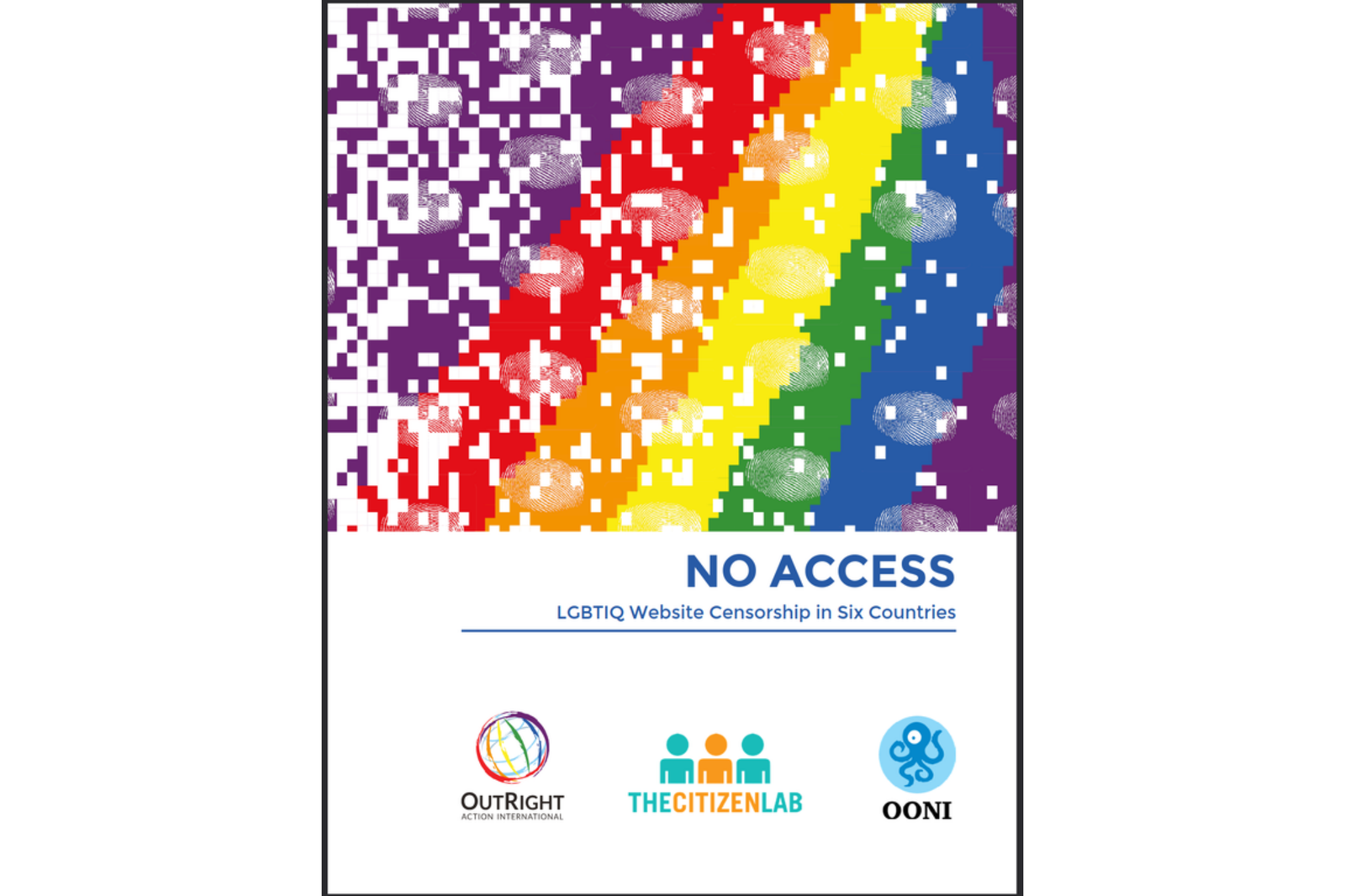
No Access: LGBTIQ Website Censorship in Six Countries
Report on which LGBTIQ websites are blocked in Indonesia, Malaysia, Iran, Russia, Saudi Arabia, and the United Arab Emirates (UAE)
Key Findings from the report
-
Methods of censorship are relatively transparent in all six countries. ISPs serve blockpage notifications informing users that the page in question has been censored.
-
The highest blocking consistency was found in Saudi Arabia, where most LGBTIQ URLs5 were found blocked more than 75% of the times tested, but blocking appeared to be inconsistent in many settings.Inconsistency was observed in which websites were
blocked (or not) across countries and, in some cases, by different ISPs within the same country. -
Of the six countries, we found that Iran blocks the highest number of LGBTIQ URLs. In total, 75 unique LGBTIQ URLs were detected as blocked in the country, followed by the UAE, where 51 unique LGBTIQ URLs were found to be blocked. Iran appears to have a uniform
censorship apparatus, as most ISPs not only blocked the same websites, but also use the same set of censorship techniques. -
LGBTIQ website censorship does not necessarily correlate with criminalization of same-sex relations, but it does relate to efforts to limit LGBTIQ people in exercising their rights to association and free expression, among others. Neither Indonesia nor Russia criminalizes same-sex relations, yet, in both countries, censorship targeting LGBTIQ content online is significant due to legislation curtailing “anti-gay propaganda” and restrictions against “obscene” content. In Malaysia, Iran, Saudi Arabia, and the UAE, strict adherence to Islamic law, in addition to laws criminalizing same-sex relations, have been used to justify online censorship.
-
In all six countries, LGBTIQ-related content may be wrongly construed as pornography and therefore subject to laws outlawing such content. As a result, users carefully avoid publishing or accessing information that may be construed as violating these laws, which
contributes to self-censorship. -
There are differences in terms of local and international websites that were found blocked. In Malaysia and Indonesia, all local LGBTIQ websites tested were accessible, while international LGBTIQ-websites were blocked. Iran, Russia, Saudi Arabia, and the UAE
blocked access to local, regional, and international LGBTIQ sites. -
LGBTIQ users in at least three of the six countries are at risk of online entrapment by local authorities or other malevolent actors. Members of law enforcement in Iran, Russia, and Saudi Arabia have posed as LGBTIQ people online to entrap other LGBTIQ individuals, putting them at risk of arrest, exploitation, and threats of violence.6 The presence of LGBTIQ apps on a user’s phone has also been used as grounds for intimidation and prosecution.
- No Access: LGBTIQ Website Censorship in Six Countries 5 Government efforts to block access to online content require the complicity of private-sector actors. As private companies own and operate many different parts of the Internet—such as certain platforms (e.g., Google’s Play Store), applications (e.g., BeeTalk, WeChat), social media (e.g., Facebook and Instagram), and ISPs, governments require their cooperation to implement online controls. Targeting private-sector actors complicit in facilitating censorship, therefore,
may be one avenue for advocacy. - Self-censorship is common, especially where punitive actions against LGBTIQ communi- ties (e.g., arbitrary arrest and detention) are intensifying. Such actions are often undertaken in the name of safeguarding national security, protecting children or minors, or reserving traditional norms and values.
- Online threats result in LGBTIQ activists having to continually educate themselves about new and safe methods to communicate online and circumvent censorship. In addition, activists must learn about how current and emerging technology could pos-
sibly help or harm them. This is difficult to do where access to information is already challenging, as in remote or rural areas.
| Attachments | Type |
|---|---|
| No Access: LGBTIQ Website Censorship in Six Countries | File |
| No Access: LGBTIQ Website Censorship in Six Countries | Link |
Bibiliography
| Title | Description | Date | Type | Link |
|---|---|---|---|---|
| Online LGBT Censorship Malaysia | Internet Censorship Report on LGBT Community and News Websites Blocked in Malaysia | Aug 13, 2013 | Resource |
Output of