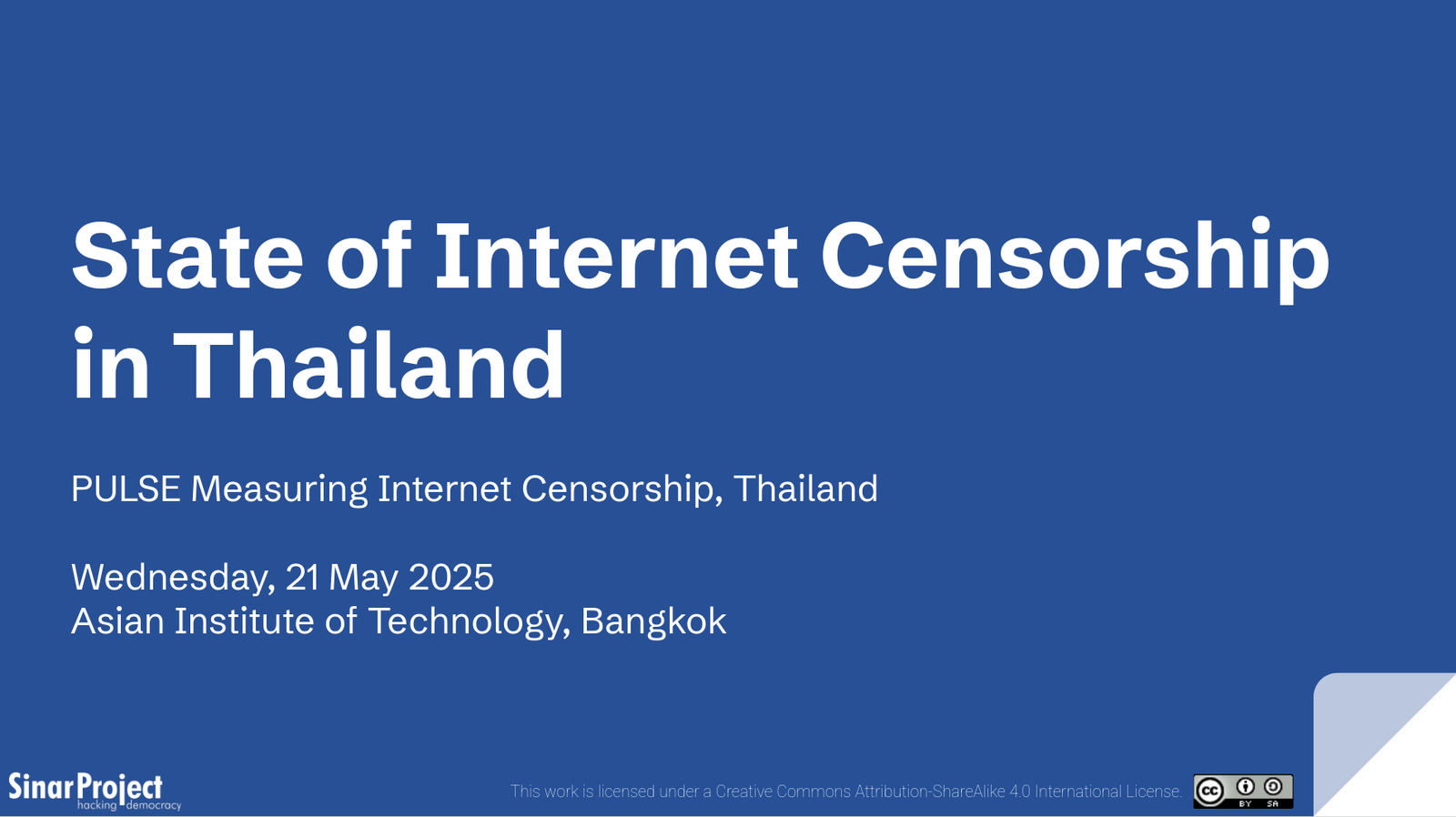
State of Internet Censorship in Thailand
Presentation on the state of Internet Censorship in Thailand
In Thailand, internet censorship continues to limit access to political content, LGBTQ+ websites, and messaging platforms. While some legal changes have taken place, many old blocking practices are still in use, and often go unexplained.
This project looks at what’s really happening online by using OONI Probe, a free and open tool that lets people test their networks and find out if certain websites or apps are being blocked. The results feed into public platforms like OONI Explorer and the Measurement Aggregation Toolkit, where anyone can explore and analyze censorship data.
Between July 2023 and June 2024, over 33 million measurements were collected across nine Asian countries, including Thailand. The data showed clear patterns of blocking, especially around protests and elections. LGBTQ+ websites were also found to be inaccessible, highlighting ongoing digital discrimination. The techniques used to block content ranged from DNS tampering to silent connection disruptions—methods that often leave no visible trace.
The project calls on governments to be transparent about their censorship practices and encourages public participation in documenting digital restrictions. It also promotes the use of DNSSEC for safer web infrastructure and invites volunteers to contribute through testing, data analysis, and community engagement.
By combining hands-on testing with policy insights, the project helps build a clearer picture of censorship in action. It also encourages transparency, invites people to contribute their own measurements, and pushes for fairer, more open internet access across the region.
| Attachments | Type |
|---|---|
| State of Internet Censorship in Thailand Presentation for PULSE Workshop | Link |
Output of