Malaysian Hansard OKU Analytics Project
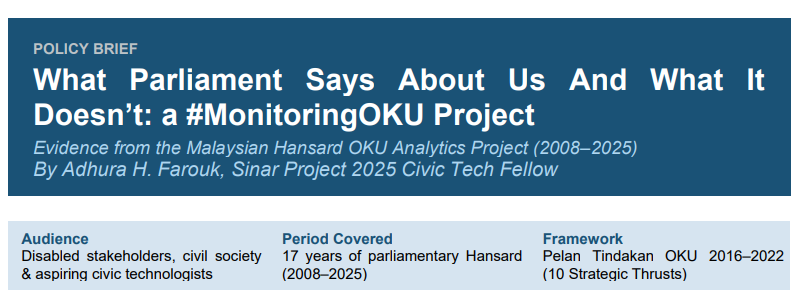
A project by our 2025 Tech Fellow, Adhura, addresses the gap in accessible information on parliamentary debates and policies concerning Persons with Disabilities (OKU) in Malaysia. By using Natural Language Processing (NLP), Hansard records spanning 2008–2025 were analyzed to quantify government attention, sentiment, and alignment with the Pelan Tindakan OKU 2016-2022.
Executive Summary
A data-driven analysis of 17 years of Malaysian parliamentary debates has been conducted through the lens of OKU (Orang Kurang Upaya) rights. This project applied natural language processing and sentiment analysis to the official Hansard record, mapping every relevant debate to the ten Strategic Thrusts of the Pelan Tindakan OKU 2016–2022.
The results reveal that parliament that debates disability in deeply uneven ways, concentrating on welfare and education whilst remaining largely silent on legal rights, economic empowerment, and crisis protection. For disabled people, civil society advocates, and those building civic technology to serve marginalised communities, this evidence base is a powerful tool for accountability and strategic advocacy.
Key Findings
Finding 1: The Policy Attention Gap
Parliamentary debate is heavily skewed towards education (Teras 3) and social welfare (Teras 5), framing disability primarily as a welfare issue. By contrast, Teras 7 (Safety & Disaster Management) and Teras 10 (Legislation & CRPD Compliance) receive negligible attention. Parliament is prioritising foundational welfare over structural rights.
Finding 2: The Implementation Deficit
Teras 1 (Accessibility) and Teras 2 (Economic Participation) consistently attract the highest volumes of negative sentiment in debate. This negativity is not directed at policies themselves, but at the chronic failure to implement them: broken public facilities, inaccessible transport, and persistent noncompliance with the 1% OKU employment quota by both public and private sectors.
Finding 3: The Concentration of Advocacy
OKU rights advocacy in Parliament is carried by a very small cohort of MPs. The vast majority of Members rarely or never raise OKU issues, and when they do, it is almost exclusively during budget debates concerning the Ministry of Women, Family and Community Development (KPWKM). OKU rights have not been mainstreamed across portfolios such as Transport or Human Resources.
Recommendations
|
For Whom |
Recommended Action |
|
Parliament & MPs |
Expand OKU debate beyond KPWKM. Involve major ministry such as Transport, Housing, Health, Human Resources. should face regular OKU-specific scrutiny. This data should be used to identify and fill the silent pillars. |
|
Civil Society & OKU Organisations |
Use the hansard_sentiment_final.csv and oku_hansard_mapped.csv datasets to produce evidence-based briefings for allied MPs. Call out the silent MPs and ministries. Celebrate the champions. |
|
Government Enforcement Bodies |
The implementation deficit finding demands an urgent audit of Teras 1 and Teras 2 compliance, particularly the 1% employment quota and accessibility standards in public infrastructure. |
|
Civic Technologists |
Extend and update this pipeline. Build public-facing dashboards that allow OKU communities and journalists to track parliamentary attention to disability rights in real time. Make government accountability visible. |
|
Disabled People & Community Groups |
Demand that your MPs engage with these findings. Ask your local representative: when did you last raise an OKU issue in Parliament? What is your position on CRPD compliance? |
| Attachments | Type |
|---|---|
| #MonitoringOKU Policy Brief: What Parliament Says About Us And What It Doesn’t | File |
Supported by