
Melissa's experience at RightsCon 2025
This article shares Melissa’s personal account of attending RightsCon 2025 in Taipei, the global conference on human rights in the digital age. She focuses on three main themes: tackling gender-based violence online, holding corporations accountable to their users, and finding creative ways to promote digital rights. Melissa reflects on sessions about intimate image abuse, deepfakes, and how these technologies can be weaponised, whether to humiliate individuals or influence elections. She highlights the legal and practical challenges in prosecuting such crimes, noting that litigation alone isn’t enough without preventative and protective measures. In corporate accountability discussions, she weighs the balance between free expression and platform responsibility, pointing to the need for stronger regulation, better cooperation with civil society, and improved digital literacy. Outside formal panels, she draws inspiration from RightsCon’s creative advocacy campaigns, from Taiwan’s your Rights, Your Flavor bubble tea initiative to sending USB sticks with information into North Korea. She also proposes ideas for Malaysia: a digital rights film festival, visible and reliable legal aid clinics, and a public campaign to pressure businesses on data privacy and scam prevention. An experience shared by one of our legal fellows, Melissa who attended the conference in Taipei recently under a grant from Luminate
This post is also available on Melissa’s blog.
A week ago, I attended a conference specific for human rights in this digital age, basically your rights in the digital space. This is RightsCon 2025 at Taipei, their return to the Asia Pacific region after a whole decade.
When I first saw the programme for the conference, I was immediately drawn to sessions about gender based violence online, corporate’s accountability towards users, and strategic litigation against perpetrators.
Gender Based Violence Online (GBV)
Basically GBV are crimes such as harassment, stalking, hate speech etc against an individual because of their gender. These crimes are now committed in a larger scale and easily committed due to technology. New abuse on people are also created with the help of technology such as doxing, cyber bullying, and deepfakes.
And oh my gosh, online grooming! You can read more on UN Women’s FAQ but I’d like to emphasise that GBV does not refer to only females, it is happening on males too.
Prior to RightsCon 2025, so much has already been spoken about what GBV is, why it’s happening, who is doing what to who. But I’m curious about what are the solutions that are available in the current framework in Malaysia’s jurisdiction and other jurisdictions, and what improvements we can make from there.
The first session I attended was about intimate image abuse.
Do you remember Taylor' Swift’s deepfake pornographic images being circulated around X in 2024? Taylor, being the one of the most influential and powerful woman in the world, was still subjected to this degradation.
The response from regulators and platform owners were painfully predictable. “We need tougher laws”; “we are improving our censorship safeguards”; and “we’re working to take the images down” is the summary of the responses. Thus far, we have not heard Taylor commencing any legal actions due to this scandal.
Now let’s talk how deepfake can affect elections, thereby affecting the whole nation. Firstly, think about what the intention of creating deepfake images / videos of influential people is. At its core, it is spreading misinformation!
Deepfake is wrong when the intentionality of it is to create new context about someone.
In 2024, Claudia Sheinbaum was running to be the first female president of Mexico and one of the deepfake videos of her that was spread is of her pitching an investment scam while a fake picture of Senator Andrea Chávez showing her face on another person’s semi-nude body was distributed around.
From the POV of a voter, you may believe these fake videos and images and they have now lose all credibility in your eyes. From the POV of a scam victim, you may blame them for “luring you” into the scam when they have not done so.
Intimate image abuse → discriminating expression and political intimidation.
Read more about AI and its influence in Mexico’s 2024 elections here!
Litigation against Perpetrators
Litigation is not the end, it’s only the beginning.
In the “Deepfakes in Courts of Law & Public Opinion: The Dangers of Forged Audios and Videos”, a speaker shared about how much more difficult it is now to admit evidence into the court of Pakistan and how litigation is only the beginning.
What caught my heart and soul was when she shared about how a man was incarcerated for stalking a woman and yet when he was accorded that few precious telephone moments from jail, he chose to call not his family but her, just to tell her that he will look for her when he is freed - because now he has proven how deep his love is for her… by getting incarcerated.
Stories like this isn’t uncommon and highlights a bigger societal issue - people don’t know what is wrong especially in the digital space.
Is texting someone every day at 5 seconds interval for an hour, wrong? Is it not just an expression of how much he longed for her?
Is asking for intimate pictures from a stranger online wrong? The targeted person can just say no if they feel uncomfortable right? “I did not force him/her, I was just asking and asking isn’t wrong.” is the prevailing sentiment that I have heard.
Then the next issue is what can the targeted person(s) do? How many times can they go to the police and do the same report on the same crime committed by the same person, only for the same person to be freed (an eventuality) and do it again.
So what we need is actually not only the “solution” of litigation and imprisonment, but also protective and preventative measures.
We went into many legal technicalities about verifying, authenticating, and admitting evidence into Court and the legislation that is available in 3 different countries (Pakistan, Indonesia, and Brazil). The summary is that:
a) there are legislations criminalising GBV, illegal recordings, and even non-consensual images but not deepfakes. How do you define and regulate deepfakes?
b) in Pakistan, there is a clear legal framework available such as the police seizing phones for verifications but it spawns more problems such as sexual history of the targeted person and privacy invasion.
c) enforcers want to charge people who abused real pictures rather than focusing on deepfakes or fake media because real pictures are more directly damaging than deepfake.
But again, at the end of the day, what we need are practical moves such as a directive on judges to not consider a targeted person(s)’ sexual history, education, awareness on what are digital wrongdoings, whether it is now a crime or not, and protective measures to the targeted person(s).
Corporate Accountability for its Users
This is a balancing act for sure!
On one hand, we want platform owners to stop the spread of misinformation, hate speech, and illegal content but still maintain free expression while being private entities where its decisions are profit driven and subjected to regulations and political pressure.
Platforms as a business starts off with a noble cause: to provide a platform for free expression of the people but once they’re big enough, they drop in standards as soon as they can in order to comply with regulations.
In a session “Beyond the TikTok Ban: A rights-based approach to regulating platforms from authoritarian countries”, one of the speakers is from Ukraine and shared about how some news and sites from Russia were banned in Ukraine before the Russian invasion and this move was questioned by many organisations. However, after the Russian Invasion happened, this was seen as a strategic move for their national security.
I guess the question here is also, does freedom implicate safety and must security be at the expense of freedom?
Which is the gist of we discussed in a few other sessions on state surveillance and technology, how social media is a double edged sword and does surveillance actually equals safety?
At the end of the day, what I garnered is that:
a) platforms need to be regulated
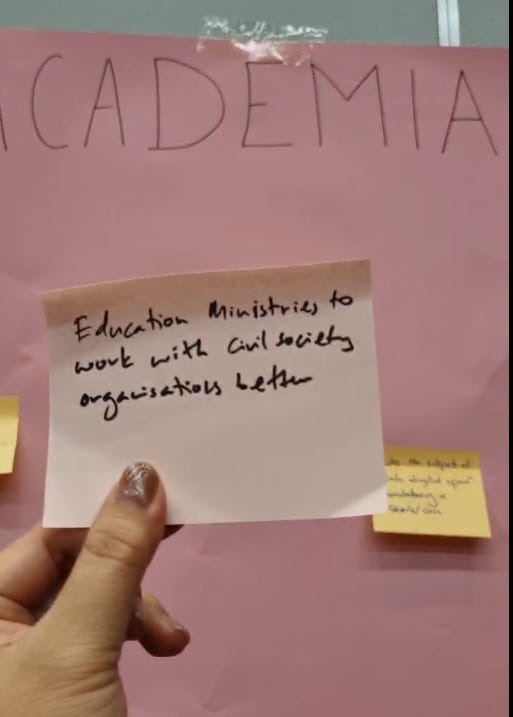
b) Governments need to work closer with CSOs and the conversation with Government needs to be reframed
c) digital literacy is very much needed
RightsCon 2025 booths
From RightsCon 2025, I deeply appreciate that human rights organisations are really creative in their campaigns. Here are some that I find unique:

Your Rights, Your Flavor campaign (or the Bubble Milk Tea campaign as I called it), where Open Culture Foundation used Taiwan’s famous beverage to indicate that everyone has different digital rights that they want to emphasise which makes up to a variety of digital rights to demand from the government.

Open Culture Foundation also created a game called Open Starter Village which is more interactive to invite people to understand the differing roles of people in open source projects.

Stickers galore to always remind people of the organisation and the causes that they champion.

This campaign to send USB sticks with content around the world to North Koreans. They receive donations by money or USB sticks and deliver it to North Koreans in creative ways.
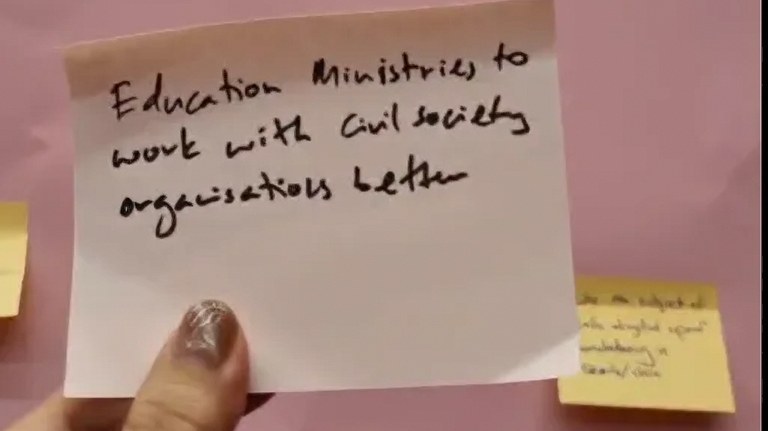
Here is my little wish from one of the sessions:

Initiatives to explore in Malaysia
There are 3 initiatives that I’d like to see in Malaysia:
-
Film fest
As a film goer, I believe that films is one of the most effective ways to deliver a message and make a powerful impact. Especially in Malaysia where people love going to the cinemas especially special film experiences such as indie movie spaces. It will be interesting to have a film festivals showcasing movies that touch on digital rights / digital wrongdoings while working with small local businesses / social enterprises to provide themed food and merch. This will attract people and spread awareness about digital rights, cyber hygiene, and consequences of abuse.
-
Legal Aid Clinics
End - to - end Legal Aid Clinics would be nice, one that has mainstream visibility and complete pipeline from taking in complaints, moving targeted person(s) to suitable organisations for protection and welfare pending investigation, help lodging reports to authorities, and litigate.
This will involve a network of connections and efforts to make known that it is a trustworthy and efficient organisation that targeted person(s) can rely on during their time of need.
This is an idea from Punjab Women Protection Authority.
-
“Help us stop scams” campaign.
What if data leaks from businesses has a correlation with the increase of scams in Malaysia and these data leaks are from businesses that are not wary enough about data leaks or even aware of how to keep data safe?
It will be interesting to have a campaign that calls on the people to pressure accountability from businesses instead of the people giving away their data freely and businesses doing away with just signing a PDPA notice.
This campaign may involve awareness about how damaging scams are, how data leaks happen, what questions to ask businesses about how user data are handled, educating businesses the standards and importance of data privacy, bring together the tech community with businesses, and what to do if there is a data leak.
Lastly, here are 2 more quotes that resonated with me:
The strategy now is to amplify a targeted person’s voice but the right to silence is equally as important
Especially in cases like doxing and public violence online, the targeted person(s) would have been exposed to an unusually large amount of attention and should be accorded some privacy as part of the solution if they choose to do so, rather than to further expose themselves.
I don’t want Zuckerberg to dictate my experience.
This is a funny but quite relevant quote! In the digital world dictated by the Algorithm God and monopoly of that few private companies, narratives shown to us may or may not be true.
Cheers!
About Author
Melissa Lim believes that legal knowledge is a fundamental right and advocates for access to justice for the people. She runs Law by Mel, an academy arm of her law firm, Melissa Lim & Associates to educate entrepreneurs on law.
Supported by